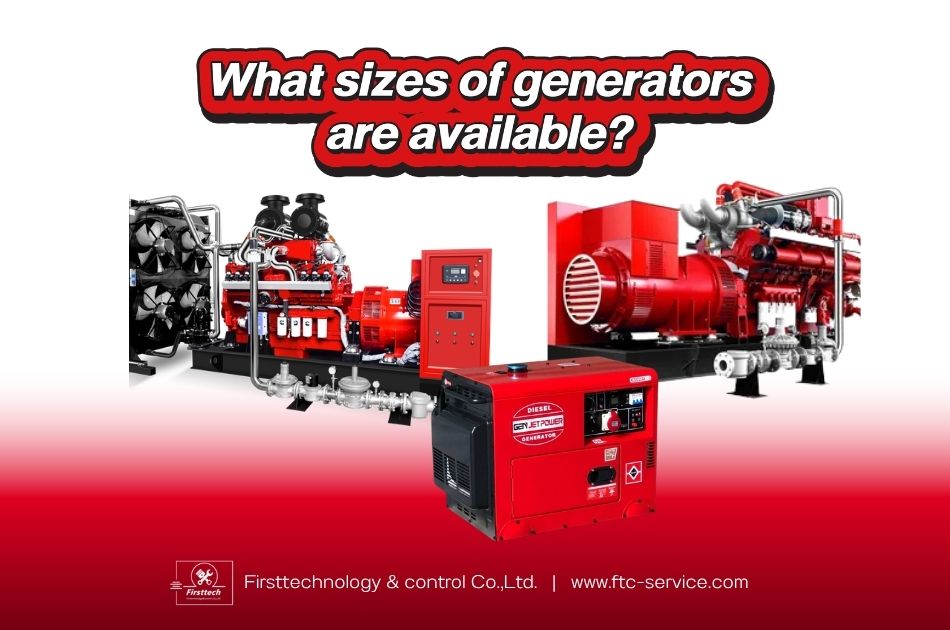
What Generator Sizes Are Available and Which One Should You Choose?
What generator sizes are available, and how does each size differ? Choosing the right generator is extremely important because it affects not only operational efficiency but also long-term safety and operating costs. Today, generators are no longer limited to factories or construction sites. They are widely used in residential homes, SME businesses, and even as backup power systems for large organizations.
One of the most common questions users ask is: What generator size is suitable for my needs?
First Technology and Control Co., Ltd., a specialist in generator sales, installation, and complete maintenance services, provides expert insights into generator size classifications and how to select the correct model to ensure every investment delivers real value and reliable performance.
Generator Size Categories
Before choosing a generator, it is important to understand that generators are not classified simply as “small,” “medium,” or “large.” They are categorized based on electrical power output measured in kilowatts (kW) or kilovolt-amperes (kVA). Generally, generators can be divided into the following categories:
1. Small Generators
Small generators typically range from below 1 kVA up to 20 kVA. These generators are designed for convenience and portability, making them ideal for producing electricity almost anywhere. Once fueled with gasoline, they can operate immediately.
Some models come equipped with wheels for easier transportation. Although compact in size, most still require two people to lift safely. In terms of size, they are comparable to common air compressors found in motorcycle repair shops.
This category includes both single-phase and three-phase generators powered by either gasoline or diesel engines, which differ significantly from large industrial diesel generators.
Advantages of Small Generators
- Cost-effective due to the relatively low price of gasoline fuel
- Lightweight and portable for easy transportation
- Can be used anywhere without relying on public electricity systems
Limitations of Small Generators
- Engine operation can be noisy
- May produce smoke and exhaust emissions
- Limited power output unsuitable for high-demand applications
2. Medium-Sized Generators
Generators with capacities ranging from 50 kVA to 2500 kVA are classified as medium-sized generators. These units commonly operate on three-phase electrical systems at 220/380 volts.
They are suitable for buildings and facilities requiring backup electricity, such as hospitals, hotels, shopping malls, banks, office buildings, and industrial factories.
These generators operate by rotating a rotor to create a magnetic field, which induces voltage in the stationary armature winding. Most systems can also be started manually during power outages.
Advantages of Medium-Sized Generators
- Provide high electrical output suitable for varied applications
- Efficient operation using high-quality fuel systems
- Durable construction with robust industrial-grade materials
Limitations of Medium-Sized Generators
- Higher cost due to more complex structures and technologies
- Require regular maintenance such as oil and filter replacement
- Produce environmental impacts from fuel combustion
3. Large Generators
Large generators with capacities starting from 4000 kVA and above are designed for industrial-scale electricity production or integration into national power distribution systems.
These generators may use various energy sources including thermal energy, water, or gas. Their operation relies on a rotating rotor generating a magnetic field, while the stationary stator produces electrical voltage. This process creates alternating current (AC) electricity at approximately 20 kV.
Large generators are ideal for industrial plants and energy facilities that require massive amounts of electrical power.
Advantages of Large Generators
- Produce substantial amounts of electricity
- Can serve as the primary power source for factories or large facilities
- Capable of direct integration with electrical distribution networks
Limitations of Large Generators
- Require intensive maintenance and monitoring
- Demand large installation areas and dedicated infrastructure
Based on these classifications, it becomes clear that generator sizes depend entirely on the actual electrical load required. While they are often grouped into small, medium, and large categories, engineering standards further divide them into more detailed classifications based on electrical load demands.
How Do Different Generator Sizes Differ?
Many people wonder how generator sizes differ from one another. In general, gasoline generators are usually smaller and provide lower power output compared to diesel generators.
Diesel generators, on the other hand, offer higher electrical capacity and are better suited for continuous heavy-duty applications such as industrial factories and large machinery operations.
For everyday residential use, such as home backup power or light electrical applications, small gasoline-powered generators are often the more practical and economical choice.
How to Calculate the Right Generator Size
Before purchasing a generator, it is essential to determine the actual amount of power required. Different generator sizes provide different power capacities. Choosing an oversized generator results in unnecessary expenses, while selecting an undersized generator can overload the system and potentially damage the equipment.
The calculation process involves adding together the power consumption of all devices that will operate simultaneously. This is known as a Load Calculation.
Example of Total Load Calculation
- 10 light bulbs × 36W = 360W
- 3 televisions × 145W = 435W
- 1 rice cooker × 720W = 720W
- 4 fans × 75W = 300W
- 1 water pump × 300W = 300W
- 1 refrigerator × 128W = 128W
Total Power Consumption = 2,243W
Therefore, the selected generator should have a power capacity of at least 2,243W to ensure safe and efficient operation.
Factors to Consider When Choosing a Generator Size
Selecting a generator involves more than simply checking the power rating. Several technical factors must also be considered.
Load Type
- Resistive loads such as lighting and heaters require stable power
- Inductive loads such as motors and pumps require higher startup power
Incorrect calculations may overload the generator and lead to equipment damage.
Electrical System Requirements (Single Phase / Three Phase)
- Residential homes typically use single-phase systems
- Factories and medium-to-large businesses generally require three-phase systems to support machinery
Operating Duration (Duty Cycle)
- Temporary usage applications may require Prime Power systems
- Continuous operation, such as hospital backup systems, requires Continuous Power generators
Installation Space and Cooling Systems
- Large generators require standardized cooling systems
- Installation areas must provide proper ventilation and noise control
Why Is Choosing the Correct Generator Size Important?
If the generator is too small, it may operate under excessive load, causing overheating and reducing equipment lifespan. Conversely, choosing an unnecessarily large generator increases both investment and maintenance costs without delivering proportional benefits.
Accurate load analysis performed by professionals is therefore essential.
First Technology and Control Co., Ltd. provides expert engineering teams capable of calculating electrical loads and designing generator systems tailored to each customer’s needs. Their solutions prioritize efficiency, safety, and budget optimization while maintaining strict engineering standards and utilizing modern technologies.
As a result, generator systems maintained by First Technology and Control offer stable performance, reliable operation, and uninterrupted business continuity even during emergency situations.
Conclusion
When asking, “What generator sizes are available?” the answer depends on the electrical power required for the intended application.
- 1–10 kW generators are suitable for residential homes
- 10–100 kW generators are ideal for medium-sized businesses
- 100 kW and above generators are designed for factories and large organizations
Selecting the correct generator requires proper analysis of load types, electrical systems, and operating duration.
Working with experienced generator specialists such as First Technology and Control Co., Ltd. ensures that every generator size selected is efficient, reliable, and fully capable of meeting real-world energy demands.