
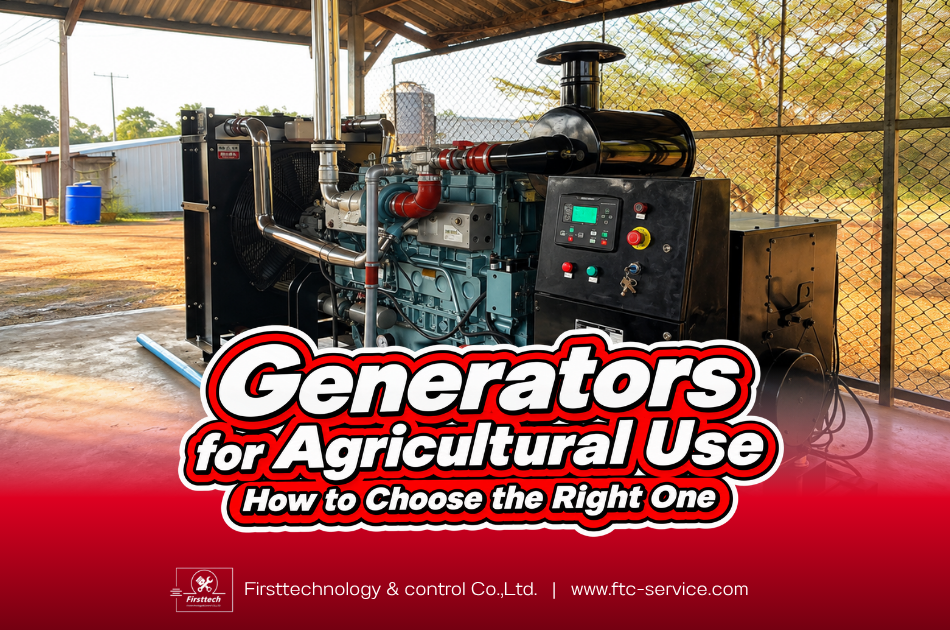
Generators for Agricultural Applications: An in-depth guide on how beginners can choose and install the right generator. Whether it is used for smart irrigation systems, closed greenhouses, or agricultural product processing, a reliable source of electrical power is essential. However, in agricultural areas where the electrical grid has not yet reached, or where common problems such as voltage drops and power outages occur frequently, a “Generator” becomes an essential backup device that farmers should have on their farms.
Types of Generators Commonly Used in Agriculture
Generators available on the market can generally be divided into 2 main types based on the type of engine used. Each type has clearly different advantages and limitations:
Gasoline Generator
- Who is it suitable for? Small to medium-sized jobs, applications that require frequent relocation, and intermittent operation rather than long continuous use (around 3-4 hours at a time).
- Advantages: Lightweight, easy to start in cold weather, and generally more affordable to purchase.
- Limitations: Gasoline costs are higher than diesel, and it is not suitable for continuous operation throughout the day or overnight.
Diesel Generator
- Who is it suitable for? Heavy-duty applications, large farms, and operations that require electricity continuously throughout the day and night (such as livestock buildings or large water pumping systems).
- Advantages: Strong and durable, consumes less fuel relative to the amount of power produced, and generally has lower long-term maintenance costs.
- Limitations: The unit is heavier, more expensive than a gasoline generator, and produces more noise (unless it is a soundproof or silent model).
How to Calculate Power Requirements (Watts) Before Buying to Prevent Generator Damage
The most important rule is that you should never choose a generator with a power output that exactly matches the rated power of your equipment. This is because most agricultural equipment, especially equipment with motors, produces a surge of power known as Starting Wattage during startup, which can be 2-3 times higher than normal operating power.
Simple Calculation Formula for Beginners
- Check the wattage (Watt) of all equipment that you want to operate at the same time (this information can usually be found on the equipment label).
- Separate equipment that contains motors. Multiply the wattage of each motor-driven device by 3 to allow for startup power.
- Add all wattages together and then include approximately 20% extra capacity as a Safety Factor.
- Calculation example: If you want to operate a 1,000-watt submersible water pump, the pump may require up to 3,000 watts during startup (1,000 × 3). Therefore, you should choose a generator with a continuous power output of at least 3,500 watts (3.5 kW).
How Much Power Do Common Agricultural Devices Use?
To provide a clearer picture and make it easier to estimate the appropriate generator size, below are approximate power requirements for different types of agricultural equipment:
High Starting-Wattage Equipment (Motors/Pumps)
- Borehole Pump / Submersible Pump (1 HP): Normal power consumption is approximately 750 watts, but startup power can increase to around 2,250 watts.
- Electric Grass Cutter: Normal power consumption is approximately 1,000 – 1,500 watts, but startup power can increase to around 2,000 – 3,000 watts.
- Animal Feed Chopper/Grinder (1.5 HP): Normal power consumption is approximately 1,100 watts, but startup power can increase to around 3,300 watts.
Stable-Load Equipment (No Significant Starting Surge)
- LED Lighting: Uses very little electricity, only around 10 – 50 watts per bulb (simply calculate according to the actual number of bulbs being used).
- Battery-Powered Sprayer (while charging): Uses only around 50 – 100 watts.
- Small Egg Incubator: Uses approximately 100 – 300 watts (power consumption may increase to around 400 watts when the heating system starts).
3 Tips for Using a Generator Safely and Extending Its Service Life on a Farm
- Avoid moisture and rain. Even when the generator is used outdoors, it should always be protected with a simple shelter or roof against sunlight and rain. Never place the generator in an area where water can accumulate, as this may cause electrical short circuits.
- Follow the correct startup sequence. Start the generator and allow the engine to run steadily first. Then connect the equipment with the highest power requirement (such as water pumps) before gradually connecting smaller devices. This helps prevent the generator from being overloaded all at once.
- Do not neglect engine oil. Agricultural generators often operate under heavy loads in dusty environments. Engine oil should be changed strictly according to the recommended service interval (typically every 50-100 operating hours) to help extend piston and engine life.
Conclusion: Which Generator Offers the Best Value and Best Fits Your Farm?
Choosing the most suitable generator for agricultural applications depends on the size of the area and the type of work required. For a small farm where the generator needs to be moved frequently and is used only a few hours per day, a 3-5 kW gasoline generator can provide a practical solution at a more affordable cost. However, for a large farm or closed greenhouse that requires continuous power for high-horsepower water pumps over long periods, investing in a diesel generator rated at 5 kW or higher can help reduce fuel costs and provide significantly better long-term value. For more information, please contact First Technology & Control Co., Ltd.. Our experienced engineering team is ready to provide comprehensive system support.
Frequently Asked Questions
Q1: Which is more fuel-efficient, a gasoline generator or a diesel generator?
A: A diesel generator is generally more fuel-efficient in the long term because diesel engines have higher fuel-combustion efficiency and consume less fuel than gasoline engines when operated continuously for extended periods.
Q2: What generator size in watts (kW) is required to operate a 1 HP water pump?
A: A generator rated at 3.5 kW (3,500 watts) or higher is recommended because a 1 HP water pump normally consumes approximately 750 watts. However, when the motor starts, startup power may surge to as much as 3 times the normal level, or around 2,250 watts. Therefore, additional generator capacity is required for safe operation.
Q3: Is an Inverter Generator necessary for agricultural applications?
A: It is necessary primarily for applications involving sensitive electronic equipment, such as Smart Farming control systems, CCTV cameras, or computers, because an inverter generator provides cleaner and more stable electrical power. However, if the generator is only used for water pumps, lighting, or standard grass cutters, a conventional generator is sufficient and is generally more cost-effective.